Chronica minora
One of the more unusual aspects of medieval religiosity, given the high degree of fanaticism reached, was the cult of relics, which are inextricably linked in the peninsular kingdoms to worship saints. Among them were the martyrs of the Church, because of their status of illustrious sons of the Christian community, which enjoyed a greater veneration. The possession of the remains of one of them, albeit in a small part, was a guarantee of prestige for any reason and religious center of worship and pilgrimage by any visitor to the treasures of the temples.

One of the best documented cases in our region is the monastery of Santa Marta de Tera. Quoted sources from the year 979, had been founded on the River Tera in honor of the patron saint of Astorga, probably in the early tenth century A document of 1033 gives us to understand that here also worshiped Salvador, Santa María, San Miguel Archangel, Santiago, San Andres and San Mateo. Some years later, in 1063, the monastery was solemnly given by Ferdinand I to the Bishop of Astorga, Ordoño in reward and thanks for bringing some of the Christian lands expected relics in the Kingdom of León, the Isidore of Seville.
On these devotions have to put a set of three wooden boxes lipsanotecas or to the custody of relics. Released some years ago by Angel Panizo, a testimonial interest must be added the information they provide on the evolution of English saints. The boxes are accompanied by their corresponding real , which includes the list of relics deposited.
is in 1115 when we began to have evidence of the arrival here of pauperes, those who are staying on the premises monastic. The news coincides precisely with an allusion to the presence of the Apostle Santiago among the saints object of worship within its walls. Another document of 1122 suggests that the cult of St was directly related to the custody of some of his relics, together with the holder of the holy saints and other unspecified. Flórez makes us understand that the remains of the virgin and martyr were transported from Astorga at some point to his monastery on the banks of Tera.
On these devotions have to put a set of three wooden boxes lipsanotecas or to the custody of relics. Released some years ago by Angel Panizo, a testimonial interest must be added the information they provide on the evolution of English saints. The boxes are accompanied by their corresponding real , which includes the list of relics deposited.
is in 1115 when we began to have evidence of the arrival here of pauperes, those who are staying on the premises monastic. The news coincides precisely with an allusion to the presence of the Apostle Santiago among the saints object of worship within its walls. Another document of 1122 suggests that the cult of St was directly related to the custody of some of his relics, together with the holder of the holy saints and other unspecified. Flórez makes us understand that the remains of the virgin and martyr were transported from Astorga at some point to his monastery on the banks of Tera.

But is a degree of Alfonso VII which gives us a much more complete type of activities in the sanctuary. His writing casts some doubt on its authenticity because of its peculiar structure and confirming its poor payroll, but it illustrates the existing environment of religious fervor in these years. In the long preamble to the document, dated 1129, the king lists the many miracles wrought at the shrine through the intercession of the holy martyr, knowledge of which likely led to a trip, perhaps on pilgrimage to the banks of Tera suffering from a serious illness : ".. Audiens magna et fines virtutes miraculously, necnon quas fecit et facit Deus per suam beatissimam martyrem virginem Martham et quod in ecclesia sua dominus reddit caecis visum, surdis auditum, claudicantibus gressum, maimed Curat, infirmed Sanat, lepers Mundat, daemons ab oppresis corporibus Fugate, et etiam ligated to vinculis Ferreisen ubicumque fierint ligati Liberate ".
Paragraph highly reminiscent of the healing powers attributed to the apostle James in his sanctuary of Galicia. For the healing power of the Holy lore claimed that returned "in sight to the blind, the deaf hear, the mute words, the dead to life ...". He also has related the story to the many miracles wrought by intercession on the road, collected for example in the Codex Calixtinus. Although the document does not say Santa Marta, the prayers of the monarch should have the desired effect, otherwise form does not explain the generous supply inserted below all that could be of royal or county within the preserve, as was established by his great-grandfather Ferdinand I.

So much of the pilgrims, either in transit to other centers or final destination, came to this site, hoping to find relief or remedy for their sufferings under the properties thaumaturgic of the relics deposited, also having real endorsement of the foregoing and worthy of all credit.
But this was not the only documented case of visiting the region and veneration of relics in the Middle Ages. There were many other temples honored with the possession of sacred spoils, related in one way or another with the pilgrimages. Some examples: In 952 the occasion of a celebrated trial on the possession of the fisheries of Lake Sanabria witnesses were called under oath before the relics of St. Peter and other saints deposited in the church founded in San Pedro de Valdespino de Sanabria . Very few authors have noticed this short passage, despite being a well known diploma and above, but its content seems to suggest the existence in Sanabria, a former monastery of San Martín de Castañeda, equipped with special devotion to the inhabitants of the valley.
Lope In 1182, Freire's Hospital San John, gave the bishop of Oviedo third of the tithes of the church of San Juan de Villafan, the archdeaconry of Benavente. The church had been built by Suari, Archdeacon of Benavente, at an earlier date, giving it the inevitable relics. It also appears that had the remains of various holy monastery of San Miguel de Castroferronio, along rivers and Almucera Tera, according to a document of 1015. In 1216 was consecrated the church of Mozar of Valverde by Peter, bishop of Astorga. The memorial includes the payroll section of the relics deposited, including those of Saints Paul, Agatha, Cecilia and Peter.
 Relics
 for James the Great were kept in the monastery of Moreruela, initially dedicated to the apostle pilgrim before Cistercian reform. The collection includes diplomatic Moreruela several examples of this title until 1163. But the remains enshrined in the monastery reached other distinguished representatives of holiness. Ambrosio de Morales, and in the sixteenth century, gave a fairly detailed documents:
"In the golden altarpiece with two side gates are closed to the Blessed Sacrament two chests of gold size, three-fourths in length, and half a yard high with the tomb, which are many relics. The one is half of S. Main Froylan, who gave it to Leon Church of long ago. Canillas are five different bones, a back, and some spondylo and ribs: there is more evidence that Scripture or tradition have been so into each other. They also have a large cloth, on average savannah, where the bones came wrapped the trugeron Quando de Leon: Lions are all cultivated, and it seems very old. They have a big bone of S. Blas with no more evidence of tradition, and that all the land of ancient time has great devotion to this relic. All other relics are tiny. "
Elaborating on the theme, Yepes adds to this relation fragments of the True Cross, relics of St. Benedict and St. Bernard, and other bones are not specific but of great devotion, taking the Cistercian monks set by most existing wealth and treasure on earth.
Nogales Monastery was another stop on the way for the pilgrims and devotees of the Relics. Ambrosio de Morales again is who with skepticism, we are aware of their "treasures" and their power of attraction for the popular religiosity:
"Relics have many tiny: the most major is a Quill of St. Anthony of Egypt , tucked into a silver arm. The testimony Desta Relic are old and richness of setting: the tradition that comes from far away. It is large and very old the veneration in which this relic is taken, and the general devotion of all the earth. Bone is a foot in length, and is always kept in the custody of the Blessed Sacrament. Shank Arm have a whole quasi S. Lorenzo, wrapped only in a taffeta, with no more evidence that an ancient tradition that has come from each other. "

De San Martín de Castañeda, Morales claims not to have relics, and books or real burial, having been burned in the past the monastery. While Yepes later corrected the famous chronicler of Cordoba, at least with regard to books and documents.
Thus, relics and all the fanaticism that swirled around them were one of the key motivations for going on pilgrimage to a monastery or other, there is a proportional relationship between the influx of visitors and the amount and quality of treasured spoils. Along the same lines, would also be an object of veneration for the graves most prominent members of royalty and nobility, of the abbots of monasteries and of those spiritual virtues recognized characters in the eyes of the devotees.
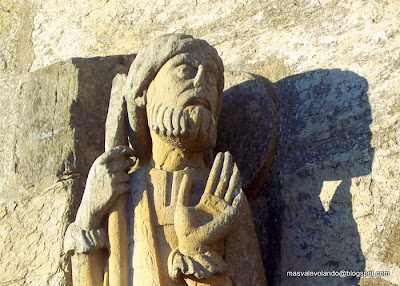
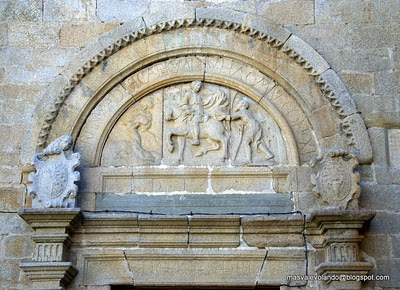
Images: 1. Lipsanoteca of Santa Marta de Tera [eleventh century] 2. Santiago pilgrim image of Santa Marta de Tera, 3. Tympanum of the West of San Martín de Castañeda, 4. Monastery Chapter House Moreruela and 5. Ruins of the monastery of Nogales.
See also the following article available in PDF Description: R. GONZÁLEZ RODRÍGUEZ, "monasteries, pilgrimage routes and road infrastructure in the north of Zamora" Brigecio. Revista de Estudios de Benavente and Lands, 10 (2000), pp. 45-66.
Images: 1. Lipsanoteca of Santa Marta de Tera [eleventh century] 2. Santiago pilgrim image of Santa Marta de Tera, 3. Tympanum of the West of San Martín de Castañeda, 4. Monastery Chapter House Moreruela and 5. Ruins of the monastery of Nogales.
See also the following article available in PDF Description: R. GONZÁLEZ RODRÍGUEZ, "monasteries, pilgrimage routes and road infrastructure in the north of Zamora" Brigecio. Revista de Estudios de Benavente and Lands, 10 (2000), pp. 45-66.


