Chronicle Desolation
Castrotorafe
The depopulated stands on a small plateau, on the shore Esla left, guarding a strategic pass over this river. The land is currently included the small town of San Cebrián de Castro, of just 363 inhabitants within the region of Zamora Tierra del Pan's municipal Fontanillas annexed includes the Castro.
Access is from the N-630, right on Via de la Plata, on a track perpendicular to start this road about two miles south of Fontanillas de Castro. The path leads the visitor directly to the remains of one of its ancient gates, on the eastern front. The defense system took advantage of a wide plateau with steep drop to the river and bounded by two small gullies that drain into it.
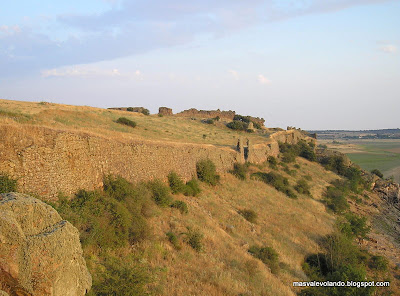
Access is from the N-630, right on Via de la Plata, on a track perpendicular to start this road about two miles south of Fontanillas de Castro. The path leads the visitor directly to the remains of one of its ancient gates, on the eastern front. The defense system took advantage of a wide plateau with steep drop to the river and bounded by two small gullies that drain into it.

On the remote origin of the population and timing of settlement, lack of systematic archaeological excavations, there are no more than guesses. Usually identified with the "Vico Aquarius' Roman, one of the milestones listed in the Antonine Itinerary . Certain findings in surface materials Roman chronology, or even earlier, have come to underpin this hypothesis, although not conclusive arguments.
The first mention in the sources seems to be the year 1038 when the territory quoted ad Torab "or" Adtorabe "as close to the monastery of Moreruela, a donation from the Countess Sancha, daughter of the counts and Elvira Fernández Munio. The data has an interest, it makes manifest the existence of a territorial center of some entity with dependent towns or villages, including irrigation. is from 1129 when Castrotorafe strong comeback in the context of repopulating momentum developed in the kingdom of León. This year Alfonso VII granted the privileges of Zamora and assigns a first alfoz. But will his son, Ferdinand II, who made this a prominent location within the political organization of the kingdom, in fact it is he who chronicles attribute the repopulation of the town: "this King Ferdinand settled ... Castrotorafe in the diocese of Zamora.."
In 1176, Castrotorafe is given to the Knights of Santiago headquarters of the Order: "Villame opinion Castro et Toraf per terminus novinssimos antiques, and two years later, in 1178, Pedro Fernandez, Master of the Order granted a new charter confirmed by Fernando II himself.
at this time must have been built first walled enclosure, and perhaps up the famous bridge over the Esla, a major viaducts in the area providing access to Zamora from the northwest territories Galicia and Portugal.
In 1176, Castrotorafe is given to the Knights of Santiago headquarters of the Order: "Villame opinion Castro et Toraf per terminus novinssimos antiques, and two years later, in 1178, Pedro Fernandez, Master of the Order granted a new charter confirmed by Fernando II himself.
at this time must have been built first walled enclosure, and perhaps up the famous bridge over the Esla, a major viaducts in the area providing access to Zamora from the northwest territories Galicia and Portugal.

The defense of the bridge and castle guard increased the visibility of this enclave in the early thirteenth century, which was amended several disputes between Order of Santiago, the bishop of Zamora, the Pope and daughters of Alfonso IX, Sancha and Dulce. Alfonso IX in 1202 granted to the cathedral of Zamora the whole tithe of toll for the rebuilding of the cloister of San Salvador and San Miguel, a tax that would be closely linked, as in other places, with the management and control of the bridge.
In April of 1222 the bishop of Zamora reached an agreement with the Master of the Order concerning the tithe of the toll and watermills here. The master gave up all rights to the toll and half the mill of Figal and Bishop renounced all claims to the tithe of the toll and the mills of Castrotorafe.
miter differences between Zamora and the Order of Santiago on the payment of tolls and pasagium in Castrotorafe by the residents of the Lampreana Manganeses led to a new agreement, signed in 1229 by the bishop and the master. The promises Order unenforceable, the said neighbors can buy and sell Castrotorafe. For these same years several documentary references of the Cathedral of Zamora, bequests from wills, witness the activity at the bridge.
miter differences between Zamora and the Order of Santiago on the payment of tolls and pasagium in Castrotorafe by the residents of the Lampreana Manganeses led to a new agreement, signed in 1229 by the bishop and the master. The promises Order unenforceable, the said neighbors can buy and sell Castrotorafe. For these same years several documentary references of the Cathedral of Zamora, bequests from wills, witness the activity at the bridge.

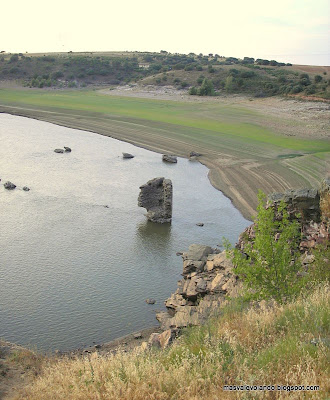
For the construction of the viaduct took a backwater of the river, caused by the action of "extremely violent curve previously developed" in the words of Gomez Moreno. Granada archaeologist places its construction at the end of the twelfth century, noting that consisted of twelve or more arcs "and sunken piles of polygonal cut against the grain and spurs to the opposing party, with rather clumsy approach. Its foundations persevere in the river , and four batteries, made of thick masonry, rocks appear on the opposite bank. " The impressive system of fortifications of the town had always considered the protection of this infrastructure, because from the angle northwest of the castle wall as a coracha down to the river, where are located the remains of a tower that would serve to spur the provision of water and monitoring.
Based on indirect evidence, some authors have argued that the mid-sixteenth century the bridge collapsed definitely not going to rebuild. May have to delay at least several decades this situation, since the visit to parcels of 1528 Peñasuende Castrotorafe and mentioned here a boat.
This same visit reveals the existence of a chapel dedicated to Santa Marina located near the river Esla, which parallels with respect to bridge Castrogonzalo are self-evident: "Visitation of the hermitage of Santa Marina near the village of Castrotorafe [...] The said visitors sent to Peter Constant, pastor of Castro Torafe that it takes the income from this hermitage, which makes Hazer two corners of this hermitage, which are Cayden Hazi the river, the quale made of stone and lime, according to the wall that is cast. "

In any case since the late fifteenth century has been a great bridge collapse, the details refer to the first destruction that could be traced even the fourteenth century and that could be short:
"Visytamos Baxo a bridge that is the strength in that Ryo, which is Cayden, arches her, but three that are healthy, and all the pillars of Paresce other grand part above water, they do not know ynformados FUEM sy sy is dropped or overthrown because ay the memory of that dello onbres agreed. "
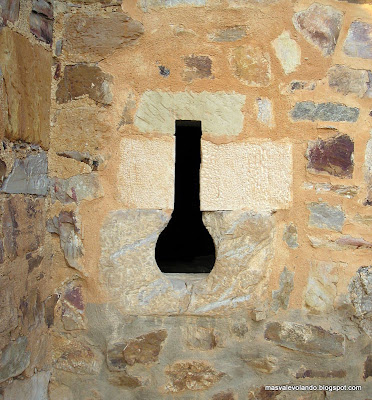
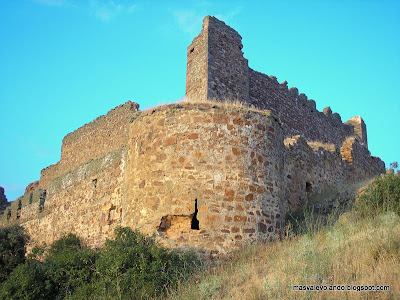
Images: 1. Given the near Castrotorafe in the west, towards 2. Remnants of the broken bridge over the river Esla 3. The Castle from one of its hubs, recently collapsed, 4. Vista del Castillo 5. Pocket artillery.
This is a visit in 1494. The same source informs us of the economic and strategic importance that this step condecían Santiaguista: "If that bridge is hiziese, rent the said task hundred miles mrs. But in dende up, because all the people comes from Portugal to Castile Fery Verny by the turnpike rendyese ally much. "
From these dates the references to this town lacking in diplomatic collections, an obvious sign of loss of strength, to which should contribute significantly to the destruction of the bridge. Today, when the reservoir is low waters, you can still see the starts of their batteries in the riverbed.
The castle in ruins, is located at the northwest corner of the fortified enclosure. It features a trapezoid with a double defense system. First striker slotted barrier with four circular towers angles and, on appeal, a main body isolated from similar plant, now virtually unrecognizable. The General Answers
Cadastre of Ensenada, in 1751, states that "in these wilds acted and operated as territory that grabs their enclosure, which is all around the stone wall, with buckets , and has four arched doors through which enter it, each with its name, and has for four hundred yards east to west and from north to south four hundred and ten, a quarter of a mile circle. "
From these dates the references to this town lacking in diplomatic collections, an obvious sign of loss of strength, to which should contribute significantly to the destruction of the bridge. Today, when the reservoir is low waters, you can still see the starts of their batteries in the riverbed.
The castle in ruins, is located at the northwest corner of the fortified enclosure. It features a trapezoid with a double defense system. First striker slotted barrier with four circular towers angles and, on appeal, a main body isolated from similar plant, now virtually unrecognizable. The General Answers
Cadastre of Ensenada, in 1751, states that "in these wilds acted and operated as territory that grabs their enclosure, which is all around the stone wall, with buckets , and has four arched doors through which enter it, each with its name, and has for four hundred yards east to west and from north to south four hundred and ten, a quarter of a mile circle. "
also is hereby given that the desert only a person lives, poor solemnity to be exact, and therefore exempt from contributions, "... is based in the wilderness only a Santero or hermit, who cares for the church. There is a house with high and low room, where she lives the hermit. It is separated from the church and used for guest quarters of people in many parts down to visit the holy image, which is placed in this church and is titled the Realengo. Whose house is owned by his Majesty. "

regard to the castle is described as: "There is a castle, with its upper and lower house, which is uninhabitable. Is your tower and barbican, and is typical of holders of the Knights of Castro, who today is the Marquis de Galiano [referring to Juan Pablo Galiano and Chinarca, I Marquis de Galiano since 1746], Knight of the Order of Santiago, Mayor of the Royal Site of San Ildefonso, and said that he formerly resided in eight commanders, and not run like today is this castle destroyed and ruined by neglect. "
The depopulated Castrotorafe was declared a National Monument on June 3, 1931. On 5 May 1949 did the same with the castle. Today both buildings included on the inventory of Castile and Leon as a Cultural, in the category of "archaeological site" and "Castles", respectively. The ownership of all the ruins of the Castle, Chapel Wall and corresponds to the Provincial de Zamora free transfer under the State granted by public deed dated November 5, 1976, with the aim of ensuring their preservation. Images: 1. Given the near Castrotorafe in the west, towards 2. Remnants of the broken bridge over the river Esla 3. The Castle from one of its hubs, recently collapsed, 4. Vista del Castillo 5. Pocket artillery.


0 comments:
Post a Comment