Chronica Minora
Tábara
The villa is situated in the north-central province of Zamora, at an altitude of 744 m. on sea level. The population serves as a hub for what is geologically known as Depression of Tabara, along the foothills of the Sierra de la Culebra, and next to the mountain of the Caverns and Carver. Its strategic location and its status recognized place of passage for some of the busiest routes of the northwest peninsula, have marked a decisive shape its history.
Tábara
The villa is situated in the north-central province of Zamora, at an altitude of 744 m. on sea level. The population serves as a hub for what is geologically known as Depression of Tabara, along the foothills of the Sierra de la Culebra, and next to the mountain of the Caverns and Carver. Its strategic location and its status recognized place of passage for some of the busiest routes of the northwest peninsula, have marked a decisive shape its history.
Its recorded history goes back at least to the early Middle Ages, it was Tábara an important monastic enclave wide resonance in the Kingdom of León. The monastery, dedicated to San Salvador, was probably built on some kind of late Roman or Visigothic previous installation, because she has endured some archaeological remains in area.

As recounted in the Life of St. Froilan , brief hagiographical text contained in the Bible Mozarabic Leon Cathedral, which was later bishop of León founded a monastery in the late IX, following the instructions of King Alfonso III. The same source informs us that the monastery to a thriving community gathered twofold, formed by six hundred monks and nuns. The figure is probably exaggerated, but it shows the ambition of the initial foundation: "ubi congregavit Aedificavit cenobium Taborense utrarumque sexum centi services Donimo animas servientium.
In the second half of the tenth century was in a famous monastic scriptorium were copied and illuminated a number of wonderful Blessed, which were the subject of attention of researchers and experts in codicology. These are : the Tabara (completed in 968), started by the painter-calligrapher Magius and completed by his disciple Emeterius, the Girona, written and illuminated by Emeterio Sennior and Ende in 975, and, most likely, the so-called San Miguel , Magius also work, who qualifies as a teacher Emeterio.
In the last folio of the Blessed Tábara (f. 167v.) joined the world-famous miniature of the tower of the monastery, with monks toiling inside the tasks of copying and making books. In the colophon (f. 167r.) Described the tower as high and stone materials, and laments the copyist of his own calamities thankless work: "O Turre tabarense lapideo Insupen high premium teak et ubi Emeterius tribusque Sedita incurvior mensis et cum omni calamum conquassatus membrane fuit. " The manuscript is kept today in the National Historical Archive under the symbol 1097B. Related
directly or indirectly to the Blessed Tábara other codices are kept in various archives and national libraries and foreigners, among them, and of a later age, those of Turin and strikes.
In the second half of the tenth century was in a famous monastic scriptorium were copied and illuminated a number of wonderful Blessed, which were the subject of attention of researchers and experts in codicology. These are : the Tabara (completed in 968), started by the painter-calligrapher Magius and completed by his disciple Emeterius, the Girona, written and illuminated by Emeterio Sennior and Ende in 975, and, most likely, the so-called San Miguel , Magius also work, who qualifies as a teacher Emeterio.
In the last folio of the Blessed Tábara (f. 167v.) joined the world-famous miniature of the tower of the monastery, with monks toiling inside the tasks of copying and making books. In the colophon (f. 167r.) Described the tower as high and stone materials, and laments the copyist of his own calamities thankless work: "O Turre tabarense lapideo Insupen high premium teak et ubi Emeterius tribusque Sedita incurvior mensis et cum omni calamum conquassatus membrane fuit. " The manuscript is kept today in the National Historical Archive under the symbol 1097B. Related
directly or indirectly to the Blessed Tábara other codices are kept in various archives and national libraries and foreigners, among them, and of a later age, those of Turin and strikes.
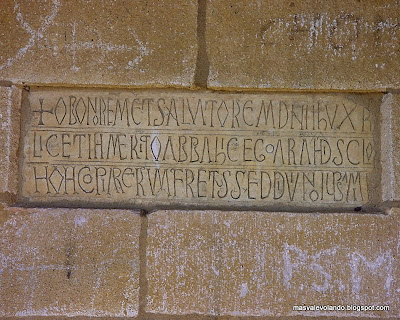
today's underground Roman temple were unearthed several archaeological marble contextualiazar have served to qualify the little news we have about the trajectory of this monastery, bases, shafts, capitals, fragments of a sarcophagus, for supporters of the altar, etc. X century we also have front row epigraphic evidence, including the possible foundation stone of the monastery, which is mentioned Arandisclo Abbot, and a funerary inscription fragment allocation problem.

The history of our monastery was interrupted abruptly in the late X. Represents the scholarly tradition that would have been prey to Mansur's campaigns to 988, so that would Tábara same fate as other monasteries as Eslonza and Sahagun, aceifas destroyed by Muslims.
In the second half of the eleventh century, the town tabarense must have possession of the Infanta Elvira, daughter of King Alfonso VI, for in his will, dated November 11, 1099 in Tabara, leaving it with other goods to great-niece Sancha: "Et Nepta control mea et Sancia that cryo Tauara Michael Bamba et cum Sancto adiuntionius Scalata suis ". The princess and her sister Urraca had received many of the monasteries linked to the royal crown, so that the possibility of maintenance in a certain monastic activity Tábara during this period is not negligible. Sancha , sister of Emperor Alfonso VII, gave his time, as the story of the Twenty Kings Chronicle all Tábara Valley to the Knights Templar. The exact date of this release is not known, but since the Death occurred in 1159 and in 1129 set as tenente Sancha of Tabara, is that the Bailiwick Templar settled in this town was one of the oldest the territory of Castilla.
on the remains of the old early medieval monastery in the second half of the twelfth century there arose a new Romanesque church, whose consecration took place in 1137 by Bishop Robert de Astorga, as shown by a caption next to the southern gate .
Wamba Division, apocryphal document of the early twelfth century draws Tábara as one of the limits of the diocese of Zamora: "The bishopric of Numancia, this is Camora, has the Penna Gusendo fasta or are the banner Tormes Val de Rey yazen sobrel, et dalli fasta in Douro, e Villalal fasta Oter of Prima assi as ua about fasta Breto Rio Seco, e Tauara fasta in Douro ".

The presence of the Knights Templar in the valley led to conflicts over the rights of bishops with the bishop of Astorga. In 1208 Pope Innocent III commissioned three dignities of Palencia to hear the lawsuit that kept the bishop of the diocese Asturicense against the Templars, because they refused to administer the prelate the sacrament of confirmation in the churches they had in Tábara. The decision was favorable to the bishop of Astorga, but the Templars not met. So in 1211 the pope commissioned the Bishop of Leon, the abbot of San Isidoro and the Archdeacon Peter Cipriániz legionense to compel the Templars to serve his sentence. Two years later, on April 18 disputes were settled with the establishment of an agreement between Don Pedro, bishop of Astorga and the Master of the Temple, Pedro Alvítiz.
The documentation for the trial of the Order shows that Carbajales Tábara and in 1310 had the same commander: frey Gómez Pérez. Joining him are mentioned more than ten other Templars apparently lived in the castle of Alba. It follows that the parcels Carbajales Tábara and formed one of the largest groups of friars of the order, exceeded only by residents in Faro. Suppressed the Knights Templar in 1312, Tabara happen due to the Crown, as was the case with other towns, if Villalpando. Last Templar
Tabara, despite the deep impression left in the village would be lost in the mists of time and fall within the scope of the legend. Still at the end of the fifteenth century neighbors vaguely remembered some details of this stage, as related in the testimony of certain witnesses in a lawsuit: "desir heard that there Tábara bivia in Madalena, which is in the midst of Tábara e Foramontanos, some friars sodomyticos Templars and that Tabara and Alkalinity lost all the land ea Tabara. "
 In September 1371 King Henry II of Trastamara Tábara donates his vassal Valderrábano Gómez Pérez, along with the towns of Alba Ready, Mombuey, Alcañices and Ayoo, which had also belonged to the Knights Holy Sepulchre. The manor, also called Old Earth Tabara, also comprised of the town, places of Faramontanos, Ferreras de Arirba, Litos, Moreruela, Pozuelo, Riofrio, Santa Eulalia and San Martín. In 1471 joined the estate duty Sesnández, Escober, Casar and bruising. Already in the sixteenth century were added Ferreruela (1510) and Abejera (1541). A mid-fifteenth century the villa belonged to the Almansa, whose domain was extended to Alcañices and Mombuey. This is the origin of the manor of Tábara that eventually reached the hands of a branch of the family Pimentel.
Tabara, despite the deep impression left in the village would be lost in the mists of time and fall within the scope of the legend. Still at the end of the fifteenth century neighbors vaguely remembered some details of this stage, as related in the testimony of certain witnesses in a lawsuit: "desir heard that there Tábara bivia in Madalena, which is in the midst of Tábara e Foramontanos, some friars sodomyticos Templars and that Tabara and Alkalinity lost all the land ea Tabara. "

mayorazgo founded in 1497 on this villa Don Pedro Pimentel Vigil de Quiñones, son of Count III Benavente, Alfonso Pimentel. A son of Don Pedro and Dona Ines Enriquez, Don Bernardino Pimentel and Enriquez received from Charles V in 1541 the title of Marquis of Tabara. The following year the Marquis and his wife Mrs. Constanza Osorio bought from the Crown Manor Villafáfila until last year that had belonged the Order of Santiago. The Pimentel tried to emulate the aristocratic villa of the Renaissance court, built his mansion, with plateresque, remnants of which still remain in the current square, where family coats abound. After residency, including Garden, with pond-and beyond, to the southeast, the forest, these spaces for recreation and hunting, just as those enjoyed by their relatives in Benavente. But also, like them, living primarily in Valladolid, where he had his main palace.


The introduction of the manorial system created tensions and disputes between lord and vassal. They complained that they could not appoint his own council as well as the limitations of natural resource exploitation, including those considered Concejil character. The town and its many paths rose to the Crown in 1528 and 1551 allegations of abuse which were considered noble. Tensions tried to settle in 1561 for the establishment of harmony and perpetual statute. It was acknowledged by harvesting and freedoms for more Old Earth, that is those of ancient origin, while in places populated by new exploitations were reserved to the lord.
extended The Marquis, in addition to the villa tabarense, to places of Moreruela of Tabara, Faramontanos, San Martín de Tabara, Santa Eulalia, Litos, Escober, Ferreras de Arriba, Ferreruela ... Its owner, the Marquis de Tabara, still enjoyed the right of submission in the churches of the Marquis in the mid-nineteenth century.
* This text was written in collaboration with José Ignacio Martín Benito. Part, with some variations, the historical review the proposal submitted to shield the village of Tabara.
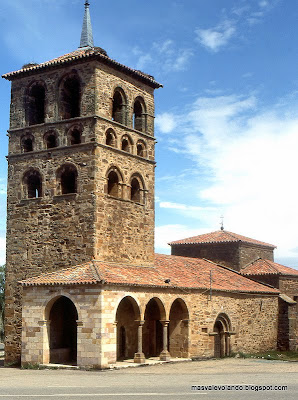
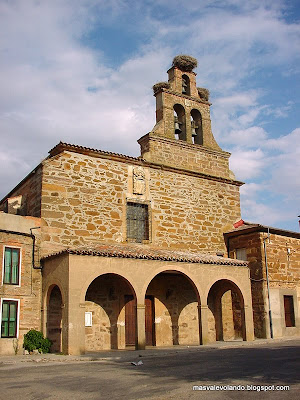
Images: 1. Overview of the church of Santa Maria de Tabara, 2. Registration founding of the monastery of San Salvador, 3. Church of Our Lady of Assumption 4. Pimentel crest lineage in the House-Palace of the Marquis of Tabara and 5. Main façade of the palace of the Marquis de Tábara.
* This text was written in collaboration with José Ignacio Martín Benito. Part, with some variations, the historical review the proposal submitted to shield the village of Tabara.
Images: 1. Overview of the church of Santa Maria de Tabara, 2. Registration founding of the monastery of San Salvador, 3. Church of Our Lady of Assumption 4. Pimentel crest lineage in the House-Palace of the Marquis of Tabara and 5. Main façade of the palace of the Marquis de Tábara.


