Heritage Pearls
The Roman historian Livy passed, with honors, to posterity for having composed a pharaonic History of Rome in 142 books. The work, known in its Latin version as Ab city libri Condit, dealt with the period between the founding of the city until the death of Nero Claudius Drusus in 9 BC. The ambitious master plan consisted originally As mentioned, of 142 books, divided into decades, or groups of 10 books, so this work is also cited as the "Decades" of Livy.
 Despite the popularity of the Prince of historians , an important part of this legacy was forgotten irreparably. The technical difficulty to produce complete copies of such extensive editing alone would explain this loss, then, until the invention of printing, all of which were necessarily manuscript. For this reason, all these books, only 35 have reached until today (from 1 to 10 and from 21 to 45). Contain the history of the early centuries of Rome from the foundation in the year 753 a. C. up to 292 a. C. Recount the Second Punic War and the Roman conquest of Gaul, Greece, Macedonia and part of Asia Minor. The contents of rest of the books we have some indirect information through certain indices preserved.
the publicity was great was the work of Livy in the Hispanic kingdoms during the Middle Ages, especially in environments courtiers and nobility. The writings of classical history and knowledge of the exploits of the great heroes of antiquity are an essential part of education of the good knights. This position is repeated several translators and writers of the time as Alfonso de Cartagena: "E acostumbrauan the caualleros why they ate Quando Estoria Leyana the great feats of arms than the other hizieran and the brains and efforts to uvieron learn to overcome and finish what I wanted and it was because I grew up reading them the HEART: e esforçávanse haziendo with the hope of arriving at what the other hizieran and go through it. " The text
Ab Urbe Condit, prior to the translation of Fray Pedro de la Vega 1520, know two versions of romance. On the one hand he carried out, based in part on the Latin text, and partly in the French version of Pierre Berçuire, Foreign Minister Pedro López de Ayala, and the abbreviated second, preserved in several manuscripts and published in Salamanca, Burgos and Toledo. This last is attributed to Rodrigo Alfonso Pimentel, II Conde de Benavente (1420-1440).

The Roman historian Livy passed, with honors, to posterity for having composed a pharaonic History of Rome in 142 books. The work, known in its Latin version as Ab city libri Condit, dealt with the period between the founding of the city until the death of Nero Claudius Drusus in 9 BC. The ambitious master plan consisted originally As mentioned, of 142 books, divided into decades, or groups of 10 books, so this work is also cited as the "Decades" of Livy.

the publicity was great was the work of Livy in the Hispanic kingdoms during the Middle Ages, especially in environments courtiers and nobility. The writings of classical history and knowledge of the exploits of the great heroes of antiquity are an essential part of education of the good knights. This position is repeated several translators and writers of the time as Alfonso de Cartagena: "E acostumbrauan the caualleros why they ate Quando Estoria Leyana the great feats of arms than the other hizieran and the brains and efforts to uvieron learn to overcome and finish what I wanted and it was because I grew up reading them the HEART: e esforçávanse haziendo with the hope of arriving at what the other hizieran and go through it. " The text
Ab Urbe Condit, prior to the translation of Fray Pedro de la Vega 1520, know two versions of romance. On the one hand he carried out, based in part on the Latin text, and partly in the French version of Pierre Berçuire, Foreign Minister Pedro López de Ayala, and the abbreviated second, preserved in several manuscripts and published in Salamanca, Burgos and Toledo. This last is attributed to Rodrigo Alfonso Pimentel, II Conde de Benavente (1420-1440).

The National Library maintains a beautiful fifteenth-century manuscript, apparently originally from the library of the Counts of Benavente had gathered at the castle of his ancestral village. Contains a condensed version and romance of the "Decades", specifically the first three. The work was commissioned to compose in 1439 by Rodrigo Alfonso Pimentel, who is described in the preface as "noble and Scientific cauallero" and declares the exemplary sense of history teaching. It is assumed that our noble personally involved in extracting its contents and set the romance version. On this basis it is assumed that the count would be the perpetrator of the text and, perhaps, the illustrator of some of his miniatures.
heads the first folio an angel carrying a shield. Several authors have identified this emblem with that of the Pimentel by the presence of bands. But Pimentel weapons of historically consisted of a shield quartered, first and fourth in a field of gold with three strips of gules, second and third in Vert, and five silver scallops start looped. The unique and ancient weapons of Pimentel are now in two Portuguese funerary monuments of the fourteenth century, and both include the venerated as an emblem.
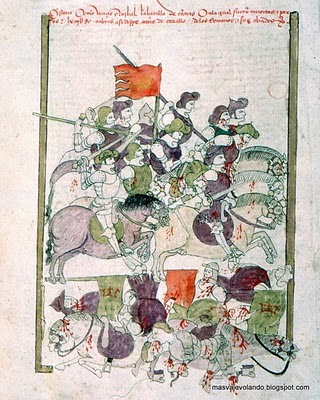
The sample contains 240 unnumbered sheets of paper. It is written in two columns in Gothic letters elegant fifteenth century, although at a reduced size and very tight, making them 43 to 47 lines per column. Titles and initials were covered in red ink, while body text gray ink was used. The text is illustrated with 13 full page miniatures, not very refined technique and invoice line already seen in the book of punishment and Documents of Sancho IV.

The images are: fol. 6v. Romulus and Remus they name the new city, fol. 8v. Emergence of the Sabines, fol. 11v. The struggle of the three Romans and the three Albanians, fol. 12v. The youth winner kills his brother, fol. 16v. The carriage of Tulia, fol. 19v. Death of Lucretia, fol. 22. How the Roman boy burned his hand, fol. 36v. Virginia death by her father, fol. 100v. Amilcar Emperor Carthage and Hannibal child of nine years fol. 113V. Hannibal's victory at Cannae batlalla, fol. 114V. Scipio and the Romans fled, fol. 171 r. Victory of Scipio over Hannibal fol. 237r. Death of Hannibal.
The full text of the preface, for the first folio of the manuscript is as follows: "Here begin three decades of Titus Libius first, that recount and recount the battles very high, dates and other things that fezieron the Romans from the founding of Rome, that were founders Romulus and Remus. E per quanto conponedor actor and Dell has all the deeds for commo Este acaesçieron because Veniero that after the best they can understand, So then to and in them many a longura prolixity of escriptura. And he tienpo actor was in the great battles between Jullie Ouo Cessar and Ponpeo, and it was natural for çibdat of Capua. E comm Alfonso Rodrigo Pimentel, Count of Benauente, the grand volume UIES reasons contained in these books, they worked and applied to the acopillar and put, non amenguando the reality judgments and Dell, in the form below. The qual acopilaçión he made, and ordered him in the year of the nativity of our Lord Jesu Christ, one thousand and four hundred and thirty and nueue years Reynante in Castilla and León in the very noble, holy and virtuous king Don Iohan, our Lord, fixed Enrrique very illustrious Don King of glorious memory, God save, and the queen Dona Maria, his wife, sets the noble King Don Ferrando of Aragon, Infante of Castile, and the prince Don Enrrique, its fixed eldest heir, and the princess Blanche, his wife, set of King of Nauarra Iohan. "

this was not the only work written in the offices of the strength of Benavente in the fifteenth century. In 1434 was completed to collect by Manuel Rodriguez de Sevilla, notary and scribe Benavente normal counts, a "crown d'Spain, a copy of the Chronicle of 1344, commissioned by Rodrigo Alonso. We know from many testimonies
several Pimentel of this century were men lovers of literature, patron of writers and promoters of copying and publication of works. Alfonso Pimentel, Conde de Benavente III (1440-1451), know the content of his magnificent library thanks to a 1447 inventory drawn towards which contains 126 volumes. Along with religious themes, philosophy, the writings of legal and medieval history, there were plenty on their shelves classical authors such as Seneca, Virgil, Lucan and Livy. Criticism puts this collection of the most representative of the English nobility in the mid-fifteenth century. Collaborators
Count III of key figures as his servant Pedro de Chinchilla. This server went on to achieve notoriety as a writer and translator. His services to the family back three generations of the count's household, as recalled in 1467 about his "Exhortation and information on good and sound doctrine" "On the other hand, was very stimulated and settled in the commandments and honest caring pleas sobrello ovo me Don Rodrigo Alfonso I date, first count of Benavente, my lord, and as this was to me more ynportançia and sharp spurs the obligation of the lot and a long criança that ove the house of his ancestors, father and grandfather, whose God save souls. "

"Here begins the book of the History of Trojan second GUID Colupna copillo, the transfer of latin qual our romance Pedro de Chinchilla, servant of Don Alfonso Pimentel, Count of Benavente, and by his order. E is first, the preface able in the Pedro de Chinchilla [...] Quando Benavente was started in the fruitful Incarnation of our Redeemer was coming to the military and four hundred and forty and three years, the solar body faciendo their course vnder Zodiac at the start of the tread mark.
Images: 1. First folio of the codex with the Prologue, 2. Scipio and the Romans who escaped [fol. 114V.] 3.'s victory in the battle Hannibal Cannas [fol. 113V.] 4. Death of Hannibal [fol. 237r.] and 5. Inrush of the Sabine [fol. 8v.].

this was not the only work written in the offices of the strength of Benavente in the fifteenth century. In 1434 was completed to collect by Manuel Rodriguez de Sevilla, notary and scribe Benavente normal counts, a "crown d'Spain, a copy of the Chronicle of 1344, commissioned by Rodrigo Alonso. We know from many testimonies
several Pimentel of this century were men lovers of literature, patron of writers and promoters of copying and publication of works. Alfonso Pimentel, Conde de Benavente III (1440-1451), know the content of his magnificent library thanks to a 1447 inventory drawn towards which contains 126 volumes. Along with religious themes, philosophy, the writings of legal and medieval history, there were plenty on their shelves classical authors such as Seneca, Virgil, Lucan and Livy. Criticism puts this collection of the most representative of the English nobility in the mid-fifteenth century. Collaborators
Count III of key figures as his servant Pedro de Chinchilla. This server went on to achieve notoriety as a writer and translator. His services to the family back three generations of the count's household, as recalled in 1467 about his "Exhortation and information on good and sound doctrine" "On the other hand, was very stimulated and settled in the commandments and honest caring pleas sobrello ovo me Don Rodrigo Alfonso I date, first count of Benavente, my lord, and as this was to me more ynportançia and sharp spurs the obligation of the lot and a long criança that ove the house of his ancestors, father and grandfather, whose God save souls. "

Likewise, Menéndez Pelayo Library maintains a manuscript with the conquest of Troy Column Guido translated by Peter Chin. The manuscript bears the signature M. 561 and was composed in 1443 in Benavente.
Text of his preface is as follows:
"Here begins the book of the History of Trojan second GUID Colupna copillo, the transfer of latin qual our romance Pedro de Chinchilla, servant of Don Alfonso Pimentel, Count of Benavente, and by his order. E is first, the preface able in the Pedro de Chinchilla [...] Quando Benavente was started in the fruitful Incarnation of our Redeemer was coming to the military and four hundred and forty and three years, the solar body faciendo their course vnder Zodiac at the start of the tread mark.
Images: 1. First folio of the codex with the Prologue, 2. Scipio and the Romans who escaped [fol. 114V.] 3.'s victory in the battle Hannibal Cannas [fol. 113V.] 4. Death of Hannibal [fol. 237r.] and 5. Inrush of the Sabine [fol. 8v.].


0 comments:
Post a Comment