The Heritage Pearl
Portillo 
"E Algund this little tienpo enanthic d'ovieron Alonso views Primentel, Earl of Venavente, and Don Ferrando Alvarez, Conde de Alva, and Don Enrique, brother of the admiral, and Suero de Quinones with King John and the prince, his son, and with the constable from Tordesillas and Toro so many for so many, on security. And being in the sights, of horse left L King of an ambush and all four were arrested, and Yogu prisoners, came the Earl of Castle Venavente Portillo and Don Enrique de Santestevan of Gormaz, hanging by ropes. ".
On this particular
different versions. As told in the Chronicle of John II, chess serves as a smokescreen to facilitate the escape of the Count as the warden gets distracted playing with it until the arrival of his supporters é he led them to where the goalkeeper was playing axedrez Count Diego de Ribera. The Count had started this game and it stopped, because Diego de Ribera not walked through the fortress. "

Portillo
The villa is located about 26 kilometers southeast of Valladolid, on the road that leads to Cuellar and Segovia. The town now comprises the core of the Arrabal de Portillo and Portillo. The first surrounded by walls and defended by the castle, overlooking a hill that overlooks the region Valladolid Pine Land, while the second, lower, is organized around the church of St. John the Evangelist and the old road from Valladolid to Cuellar. The proximity to the capital of Pisuerga historically has provided the location of great strategic importance.

The villa belonged since the second half of the fifteenth century the estate of the Counts of Benavente and then after the extinction of the lineage in the nineteenth century, the House of Osuna. During the Civil War with Portugal, the castle housed the county file, moved from the fortress of Benavente. Today the building is owned by the University of Valladolid, by donation in 1946 of Pio del Rio Hortega histologist.
On 23 September 1465 gave Prince Alfonso Plaza Alfonso Rodrigo Pimentel, IV Conde de Benavente (1451-1499). The donation must enroll in the context of the English Civil War and the grants given to the more noble cause Alfonso addicts in rebellion against his half-brother Henry IV. delivery included "all other things pertenesçientes the lordship and jurisdiction of the said town of Portillo and the said terms and jurisdiction and of thirds and other things belonging to me about it and in everything and part dello safe from alcavalas of my income and orders and gold and silver coins. " Later, once the noble sat benaventano the realistic side, Henry IV confirmed Portillo was staged in 1471 and the inauguration of the village.
Portillo's presence in late medieval chronicles will be a constant as a result of the noble struggles of the reign of the last Trastamaras.

In the "Book of bienandanzas and fortunes" of Lope García de Salazar, found in the eighteenth book "Evidence of the prison of the Count of Alva and of Venavente and Don Henry and Serum Quiñones and of their deeds. " Is told here the arrest of Alfonso Pimentel, Conde de Benavente III (1440-1451), and other gentlemen in 1448 by supporters of Don Alvaro de Luna. They were taken to the castle of Portillo, from which managed to escape shortly after sliding down ropes from the walls. These events occurred one December 18, 1448. The count had previously convinced the commandant of the fortress, Diego de Ribera, that it was appropriate to change sides now, since Don Alvaro was destined inevitably to become a loser:
"E Algund this little tienpo enanthic d'ovieron Alonso views Primentel, Earl of Venavente, and Don Ferrando Alvarez, Conde de Alva, and Don Enrique, brother of the admiral, and Suero de Quinones with King John and the prince, his son, and with the constable from Tordesillas and Toro so many for so many, on security. And being in the sights, of horse left L King of an ambush and all four were arrested, and Yogu prisoners, came the Earl of Castle Venavente Portillo and Don Enrique de Santestevan of Gormaz, hanging by ropes. ".
On this particular
different versions. As told in the Chronicle of John II, chess serves as a smokescreen to facilitate the escape of the Count as the warden gets distracted playing with it until the arrival of his supporters é he led them to where the goalkeeper was playing axedrez Count Diego de Ribera. The Count had started this game and it stopped, because Diego de Ribera not walked through the fortress. "

Also in the Chronicle of Henry IV, written by Diego Enriquez del Castillo, is made regarding the intrigues in which he was immersed in Count IV relationship with the rebellion against the Castilian monarch:
"Subcedió the Count of Benavente finding himself embarrassed and confused by aver been against the King in the past in its disservice things, wanting to amend the mistake happened, tried secretly with him, begging him I wanted to forgive and take it for him, of which the King was very happy. E and then, on a tract and convenience did Warden of Portillo, ovo the strength of his hand and took possession of the town and seized é, begged the King to make the mercy of her, which the King made freely, and gela confirmed, where it seemed to be more Conde obligation to serve as below [....] The Count of Benavente wanting to make a nice service to the King, Prince came to pass that from [the Infante Don Alfonso] de Toledo to Arévalo, accompanying the Archbishop and others who followed him partial except the Marquis de Villena, who remained on their land aviation, came one night to sleep in Portillo, where the count very well and received them with love. The Prince was quartermaster the fortress, and the Archbishop and the other gentlemen in the town. And then one morning the following day, when these gentlemen came together at the gate of the fortress, and expected the Prince to leave, the Conde de Benavente sent word that the archbishop was in good time, not because he was to Prince walk more under His command, or walk close to him that the Archbishop was very amenguado. For so the enemy between him and the Earl was seated grand time. "

"Subcedió the Count of Benavente finding himself embarrassed and confused by aver been against the King in the past in its disservice things, wanting to amend the mistake happened, tried secretly with him, begging him I wanted to forgive and take it for him, of which the King was very happy. E and then, on a tract and convenience did Warden of Portillo, ovo the strength of his hand and took possession of the town and seized é, begged the King to make the mercy of her, which the King made freely, and gela confirmed, where it seemed to be more Conde obligation to serve as below [....] The Count of Benavente wanting to make a nice service to the King, Prince came to pass that from [the Infante Don Alfonso] de Toledo to Arévalo, accompanying the Archbishop and others who followed him partial except the Marquis de Villena, who remained on their land aviation, came one night to sleep in Portillo, where the count very well and received them with love. The Prince was quartermaster the fortress, and the Archbishop and the other gentlemen in the town. And then one morning the following day, when these gentlemen came together at the gate of the fortress, and expected the Prince to leave, the Conde de Benavente sent word that the archbishop was in good time, not because he was to Prince walk more under His command, or walk close to him that the Archbishop was very amenguado. For so the enemy between him and the Earl was seated grand time. "

Portillo in the eighteenth century continued under the aegis of the Pimentel family, as recognized in General Answers Cadastre of Ensenada: "this place is a manor house belonging to the Counts of Benavente, that puts justices in them and the income from the sales taxes are perceived."
In 1751 the population of the village and its 440 neighboring suburbs included "between good and bad." The village had 350 rooms and 50 houses uninhabitable and ruined. There was also a total of three hospitals: "There are two hospitals in town, one for men and one for women, and another in the suburb for men alone." It also mentions a convent outside the walls of the population was Augustinians and consisted of up to forty religious.
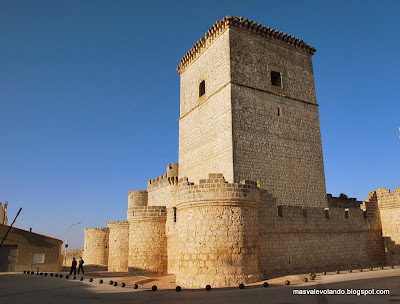
The plant and the overall structure of the castle respond Portillo a type of fortification that has been called the School of Valladolid. These baronial castles of the second half of the fifteenth century are inspired by the reform and extension of the strengths of Henry IV and have a very defined features: square, main tower of enormous proportions and internal distribution of palatial character.
Our castle has effectively defended by square blocks at the ends. The indoor enclosure double date usually in the second half of the fourteenth century. Hosts an imposing main tower of 28 meters, the fifteenth century, which has a low vaulted room with pointed arches. Above guess it two floors with wooden floors, now lost, and a magnificent vault in the top. The entrance to this enclosure is made through a cover of defensive gated arch semicircular. Al IV Conde de Benavente, Rodrigo Alfonso Pimentel, is credited with building the outer barrier artillery with its moats, the arcaded courtyard and the famous pit 32 meters deep, surrounded by a spiral staircase of 123 steps and perimeter underground rooms.

In 1751 the population of the village and its 440 neighboring suburbs included "between good and bad." The village had 350 rooms and 50 houses uninhabitable and ruined. There was also a total of three hospitals: "There are two hospitals in town, one for men and one for women, and another in the suburb for men alone." It also mentions a convent outside the walls of the population was Augustinians and consisted of up to forty religious.
The plant and the overall structure of the castle respond Portillo a type of fortification that has been called the School of Valladolid. These baronial castles of the second half of the fifteenth century are inspired by the reform and extension of the strengths of Henry IV and have a very defined features: square, main tower of enormous proportions and internal distribution of palatial character.
Our castle has effectively defended by square blocks at the ends. The indoor enclosure double date usually in the second half of the fourteenth century. Hosts an imposing main tower of 28 meters, the fifteenth century, which has a low vaulted room with pointed arches. Above guess it two floors with wooden floors, now lost, and a magnificent vault in the top. The entrance to this enclosure is made through a cover of defensive gated arch semicircular. Al IV Conde de Benavente, Rodrigo Alfonso Pimentel, is credited with building the outer barrier artillery with its moats, the arcaded courtyard and the famous pit 32 meters deep, surrounded by a spiral staircase of 123 steps and perimeter underground rooms.

The history of the fortress has not particularly outstanding feats of arms but hosted famous people in its jails, including, as we have seen, the Count himself benaventano, prison functions as did several times. In 1444 John II was held here. But his most famous prisoner was the constable of Castile, Master of Santiago and favorite of King Juan II Don Alvaro de Luna. His fall from grace led to his arrest in Burgos in early April 1453. Burgos spent the castle of Portillo, which retains a vaulted room under the main tower which tradition identifies as his prison.
The king was in a sea of \u200b\u200bdoubts about the punishment to be applied to his former henchman, but his advisers understood, in the words of columnist Perez de Guzman, as Don Alvaro "has Seyda usurper of the crown real, and has é bullied stole your income, which is cut the head and put on a nail on a cadhalso certain days, because it exemplo to all of Your kingdom Great. " passed in Portillo earned his last days before being beheaded in the plaza mayor of Valladolid on June 2, 1453.
Another aspect of the town famous for its traditional Portillo are closures across the field. The portillesas bullfights have a tradition of centuries, being among the oldest documented in Spain. The lineage Pimentel was also a promoter of any of these festivities. In 1617, the birth of the Countess of Mayo, wife of the Count of Benavente, Mr Portillo was the reason for the organization various festive activities for which they were hired comedians, competitions were held pole vault, there were fireworks ("co-eternal") and bulls.
Images: 1. Gateway to the village, 2. Overview of the Castle of the Counts of Benavente, 3. Castle's main facade, 4. Pozo and 5. View of the courtyard.
The king was in a sea of \u200b\u200bdoubts about the punishment to be applied to his former henchman, but his advisers understood, in the words of columnist Perez de Guzman, as Don Alvaro "has Seyda usurper of the crown real, and has é bullied stole your income, which is cut the head and put on a nail on a cadhalso certain days, because it exemplo to all of Your kingdom Great. " passed in Portillo earned his last days before being beheaded in the plaza mayor of Valladolid on June 2, 1453.
Another aspect of the town famous for its traditional Portillo are closures across the field. The portillesas bullfights have a tradition of centuries, being among the oldest documented in Spain. The lineage Pimentel was also a promoter of any of these festivities. In 1617, the birth of the Countess of Mayo, wife of the Count of Benavente, Mr Portillo was the reason for the organization various festive activities for which they were hired comedians, competitions were held pole vault, there were fireworks ("co-eternal") and bulls.
Images: 1. Gateway to the village, 2. Overview of the Castle of the Counts of Benavente, 3. Castle's main facade, 4. Pozo and 5. View of the courtyard.


0 comments:
Post a Comment