Chronica Minora
The purpose of this paper is to give some light on one of the oldest monasteries, yet least known, because of its ephemeral path- Zamora appeared in the north in the early medieval period. Although their existence is recognized by most authors who have dealt with one way or another the study of monasticism Leon, contradictions and misunderstandings have been obvious at the time to establish their location and determine their chronology. The fundamental cause of the confusion should be sought in the deficiencies inherent in the fragmentary documents preserved at the Cathedral of Astorga, the only source that provides first hand information about the monastery.

Yepes is the first author who deals with the subject, as with many of the monasteries in the region. In When establishing the list of foundations of the ancient kingdom of Leon Castro mentions a monastery Ferroni, on the banks of Tera, under the name of San Salvador. Provides no timeline or specific location, simply ruling that "it was the convent of monks and nuns", this is a monastery called rejoinder.
Flórez, in his famous tome XVI Sacred Spain, transmits the name of an abbess Benedicta here in 1006. His testimony has the benefit of having driven the medieval documents Asturicense before his disappearance. For the Augustinian scholar would be a community of nuns only.
We must wait until the prolific Augusto Quintana Prieto to obtain more specific. This author mentions both Castroferrol enclave as the monastery in several of his works, but it was an entry in the Dictionary of Church History in Spain where he drew a stark portrait of a monastery of San Miguel in Villaferrueña, which as we shall see later can identify with our monastery, but with a wrong location:
"Villaferrueña, San Miguel (Zamora, diocese of Astorga) Prebenedictino. The first known story dates back to 1006, you receive a gift of property. It emerged that a monastery was twofold. In 1015, the owner, Mary Chalíndez, which was donated by Bermudo II, gave to the diocese and its bishop of Astorga Jimenez (992-1028), marking the latest news that he has. Today is secular parish. "
However, reading carefully preserved diplomas concludes with clarity that this location could not be in any case Villaferrueña. The earliest references date back to mid-tenth century and not allude to any monastery. So in 962 Raup and his wife, Mansu, donate Sarracíniz Nuno and his wife, Gudigeva, a vineyard in the village of Kastro Ferronnio, Almucera riverside, who had bought to a certain Donelan, giving its terms. The mention of Almucera immediately discarded Villaferrueña option, since, as we know, this population is adjacent to Eria. The following year 963, contains a donation to the cathedral of Astorga made by Adric and his wife, Faquilo, together with their children throughout their inheritance in Castroferrol, corresponded with the few possessions, as well as their furniture, the whole half over the life of the donor and after his death entirely. Oma
IUVE In 1006, his son Veila and his wife, Gontrode, donate to the abbess and convent of Castroferronnio, which place the river Tera, all its properties and appliances, "... in anything dealing deceased honore est ecclesia vel et continentium fratrum sororum iugum et ibidem dominates Bendicta abbatissa portentibus fundatum sub monasterium qui est urbis Astor et locum predictum nominatum vocantem that dicitura nominibus Castroferronio, iuxta vel aquis flumina Teira appellant.

More explicit is a diploma in 1015 in which Mary and their children, and John Galindo Ciprianiz make donation site Castroferrol San Miguel Archangel, who dwell in there, monks and nuns, under subject of the bishop of Astorga. In this case, the villa is spatially referenced and Almucera Tera rivers: "... reconditae sunt in ipso loco, bocabulum Castroferronio Dicent quod villa, ribulose discurrente Teira et alia part Almuçara "
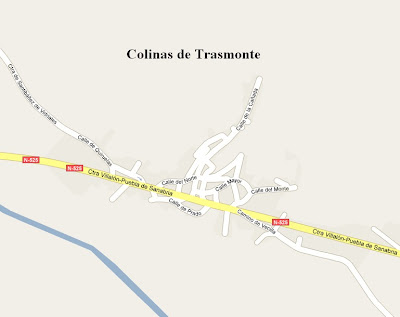
Based on these geographical constraints, the key to properly situate this monastery offers us the Madoz dictionary, which includes within the term of two Trasmonte Hills uninhabited: Pobladura of Trasmonte and Castroferrol. Today, in the collective memory of the residents of Hills has lost such a place name, although if there is instead a vague recollection about the existence of an ancient monastery.
Madoz dictionary mentioned another wilderness under the name of San Miguel de Castro Ferrol in the village of Vidriales Quiruelas immediate, less it is the same site, perhaps shared by both populations.
definitely our monastery located near Trasmonte Hills, near rivers and Tera Almucera only provide it with a site is more accurate. Two possible alternatives seem to offer based on different evidence. On the one hand we must mention an archaeological site known as San Miguel in terms of the current municipality of Vidriales Quiruelas with a cultural award for the Copper Age and modern times, collected by Larra Left in the ratio of deposits of this sector of the valley Tera.

The another option, much better documented archaeologically, payment is known as San Juan-El Valle Trasmonte Hills. This is a Roman / medieval west of the village, on a small hill that leads to the terraces above the river Tera. Not really a fort, but there are some hills nearby which might well assume that denomination.
According to the testimony of several neighbors, collected by the archaeologists, the place was known by the oral tradition as a convent of San Juan, perhaps in reference to the parish church (San Juan Bautista) or any possession of the hospital order. The extension of irrigation to the vicinity led to an intervention archeology in 1993 that revealed two occupational moments. One low empire dating from Roman times to the late IV and V century, and superimposed on it another medieval period "could be related to a type of religious building, perhaps monastery or convent, in any case for plenomedievales moments, between XI and XIII centuries, according to findings ceramics. At about 200 m. southeast of the excavation area, were previously constructed two Roman tombs tegulae, a figure that appears to extend considerably the area of \u200b\u200boccupation.
Overlapping early medieval churches and monasteries previous settlements low empire from the Roman period, mainly villae, is a well known in historiography. While the examples we Camarzana near, The Piélago (Cimanes de la Vega), and perhaps Villaquejida Abraveses Tera (Virgen de la Encina) and Los Villares (Villanueva de Azoaque).
any case, the name of this place as Castroferrol, brings this place with a group of settlements are well known: the forts, fundamental parts of the organization and hierarchy of the settlement in the tenth, eleventh and early twelfth century . In many cases these demarcations sites where tenentes, merino and executioners officials exercising their jurisdiction as royal. As has been demonstrated in archeology, in most of the cases, these early medieval settlement of Iron Age structures superimposed on the past, even prehistoric. Located on hills, and most of them fortified, were also military centers, which played a defense of the surrounding territory, in which space there were several villages.

Within the territory of what was to become the administrative district council benaventano, there were several villages that deserved the name of forts. First we should mention, for his outstanding leadership post at the same Malgré-Benavente, mentioned since 1115 as Castro quod dicitura Malgrado. They are also identified other castrates mentioned intermittently in contemporary sources: Tera Camarzana, Castrogonzalo, Castropepe, Mozar, Socastro, Ventosa, and our Castroferrol. As shown, in general, are places relatively close together, so its area of \u200b\u200binfluence may not be very extensive.
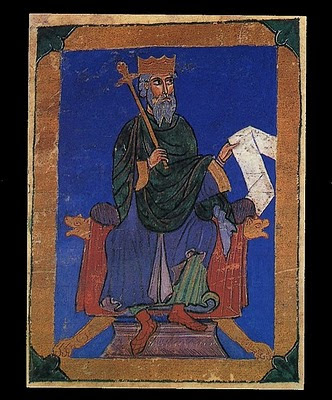
From this initial reality, there was a monastery whose history goes back at least to the time of Bermudo II (985-999). Strategically located at the entrance to the valley of Vidriales in conjunction with the valley of Tera, must take the communication flows of the old Roman road linking Bracara Augusta Augusta Asturica through Petavonium, joining just near the Via de Sanabria, a natural way to back up the river by touching Tera Zamora valley to the southeast of Galicia, through ports Padornelo and La Canda.
Its evolution is very confusing to tell, as we have seen, with an extremely fragmented documentation and not entirely reliable in the transcript.
seems that Castroferrol village, where sat the monastery of San Miguel, was previously owned by a certain Hamed. At one point Bermudo II taken or seized from Galindo Congosto Enneguez the villa in El Bierzo. His daughter Mary asked the king to some compensation for what he considered an injustice, getting in return the town of Hamed in Castroferrol. Later, in 1015, Mary and their children and John Galindo Cipriániz made donations of this town, perhaps in gratitude, with all its properties to dwell in there, brothers and sisters, under the obedience of the bishop of Astorga.

The budget is quite substantial and detailed, including liturgical objects, vestments, books, and movable and immovable property and the family properties and Araduey Vidayanes. The magnitude of the gift, accompanied by a long and solemn documentary writing, suggests a foundation, or rather a reworking from a previous center, maybe the San Salvador de Castroferrol the document of 1006 which mentions a Benedicta Bendicta or an abbess.
Changing invocation is not an unusual event in monasticism Leon, also taking into account the many vicissitudes which used to spend such institutions. It should be noted also that the monasteries often had more than one of these titles, and within a few appear as main and other as secondary. For Castroferrol, San Miguel next to Santa Maria in the diploma of 1015, otherwise identical names to the next monastery Camarzana of Tera.
We are therefore faced with another of the many monasteries that arose in the north of Zamora in the early medieval period. His little paper trail does not allow more speculation about its future development. As happened with other more established foundations like Santa Marta de Tera, San Pedro de Zamudio, San Miguel de Camarzana or San Adrián del Valle, the monastery of San Miguel de Castroferrol also ended up joining the assets of the miter Astorgano made that had precipitated their extinction as a monastic institution.
Castroferrol, as a population center, again cited on occasion. By 1060 this place is mentioned as one of the villas and estates that fell into the hands of Diego Muñoz in the division of inheritances and Mrs. Fernandez Osorio Visclavara. In 1129 Castro Ferronnio is one of the highlights of monastic preserve Santa Marta de Tera, confirmed by Alfonso VII, as was established by his great-grandfather Ferdinand I. In 1170 Fernando II again to validate such limits through a privilege confirmation.
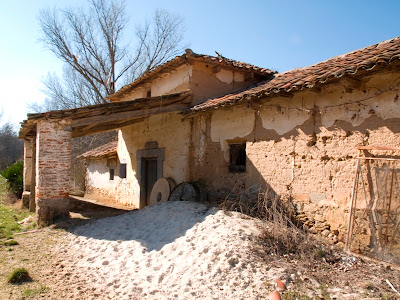
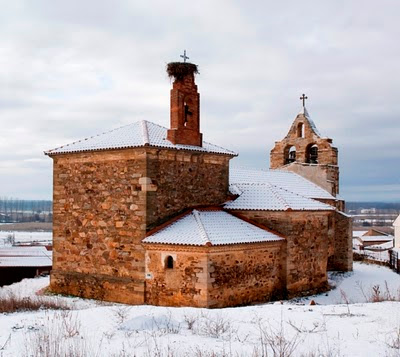
Images: 1. Trasmonte plane Hills, 2. Parish Church [Photo Luis Peral] 3. The Old Mill [Photo Luis Peral] 4. Parish Church [Photo Luis Peral] and 5. Bermudo II.
Images: 1. Trasmonte plane Hills, 2. Parish Church [Photo Luis Peral] 3. The Old Mill [Photo Luis Peral] 4. Parish Church [Photo Luis Peral] and 5. Bermudo II.


0 comments:
Post a Comment